ContentOps Review Automation
AI Automation / n8n / Content Operations
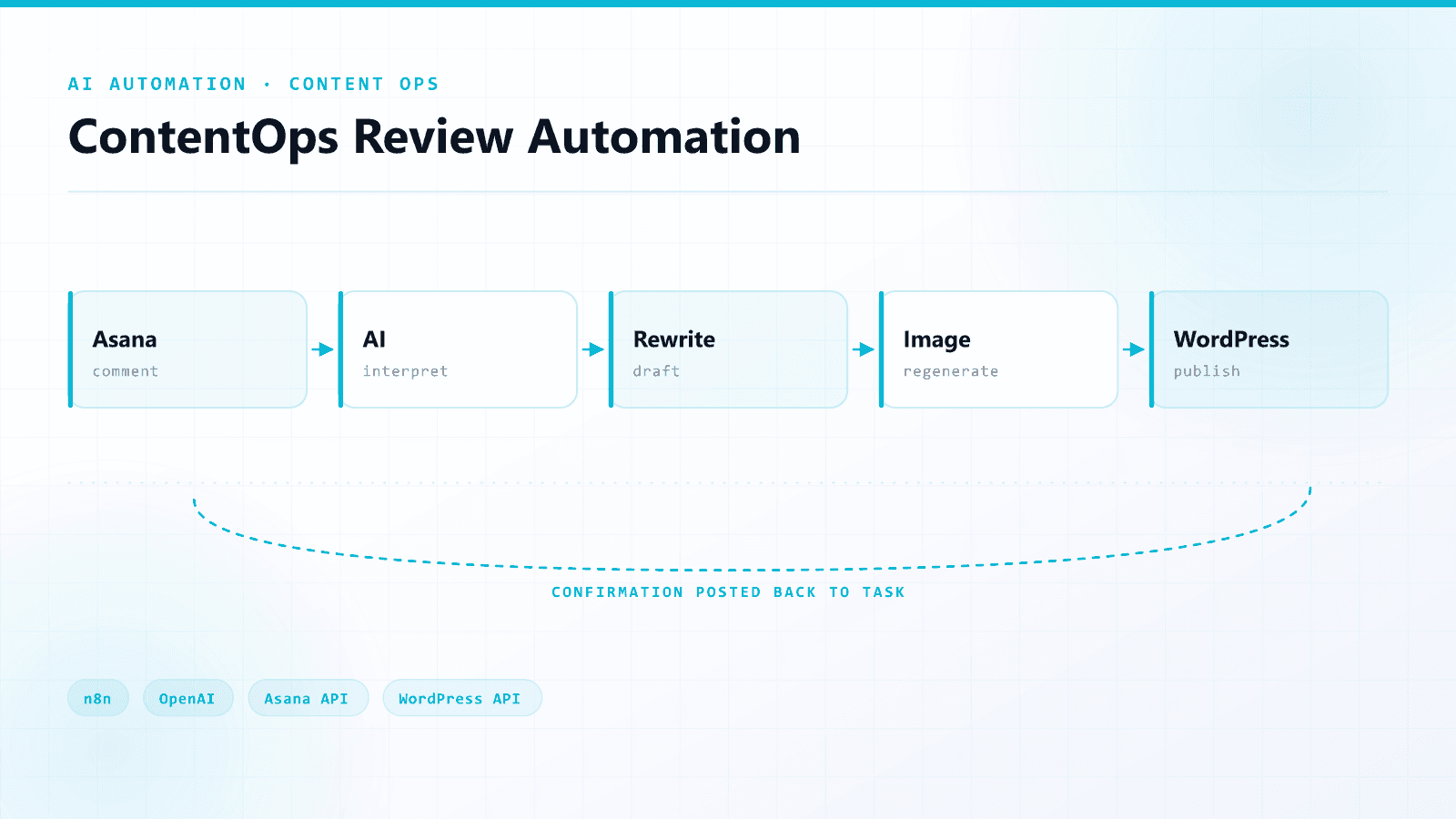
An n8n workflow that removes the back-and-forth between content reviewers and editors. When someone comments on an Asana task, AI reads the feedback, rewrites the draft, updates or regenerates the featured image, and posts a confirmation — without anyone opening WordPress.
- Year
- 2025
- Role
- Automation engineer
- Source
- Public repository
Technologies
- n8n
- OpenAI
- Asana
- WordPress
- Image Generation
- REST APIs
The problem
Content review is a queue of small handoffs. A reviewer leaves a comment, an editor reads it days later, applies it in WordPress, maybe swaps the image, then tells the reviewer it is done. The work is trivial; the waiting is not.
The solution
The Asana comment becomes the trigger. AI interprets the feedback as an instruction, applies it to the draft, handles the featured image, pushes the update to WordPress and confirms back on the task — so the reviewer's comment and the published change become the same action.
Architecture
How it is put together.
Asana trigger
A new comment on a content task starts the workflow with the task context attached.
Feedback interpretation
AI reads the comment and decides what change is actually being requested.
Draft rewrite
The draft is rewritten to satisfy the feedback while preserving voice and structure.
Featured image
The featured image is updated, or regenerated when the feedback calls for something new.
WordPress update
The revised post and image are pushed through the WordPress API.
Confirmation
A confirmation is posted back on the Asana task so the reviewer sees the result in place.
Key features
What it actually does.
- Comment-driven trigger — no new tool for reviewers to learn
- AI interpretation of free-form feedback into concrete edits
- Automatic featured image update or regeneration
- Direct WordPress publishing via API
- Confirmation written back to the source task
Engineering challenges
The parts that were hard.
Feedback is not an instruction
"This intro drags" is not an edit. Turning conversational review notes into a specific, bounded change was the core of the prompt design.
Not every comment is a request
Threads contain questions, agreement and chatter. The workflow has to decide when to act and when to stay quiet.
Outcomes
What came out of it.
Qualitative outcomes only — no invented benchmarks or metrics.
Review feedback and published change collapse into one step
No manual WordPress editing left in the review loop
Reviewers stay in Asana; the system meets them there
Next project
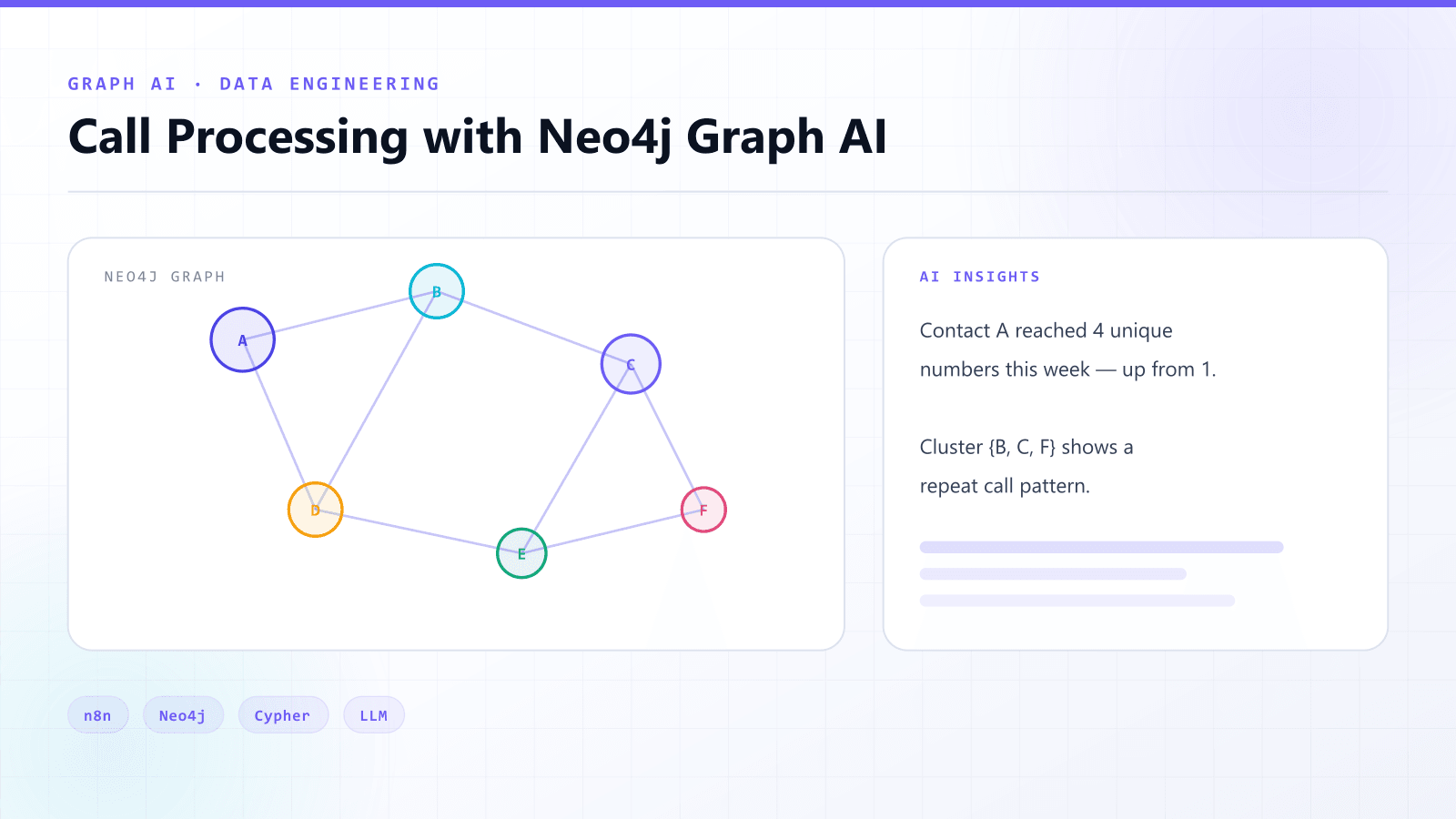
Call Processing Pipeline with Neo4j Graph AI
Raw call webhooks become a queryable relationship graph with AI-generated insights.
Let’s build
Want something like this for your business?
Tell me the problem and I will come back with an architecture, a scope and a timeline.