AI Technical Co-Founder Platform
Multi-Agent AI / LLM / Developer Tooling
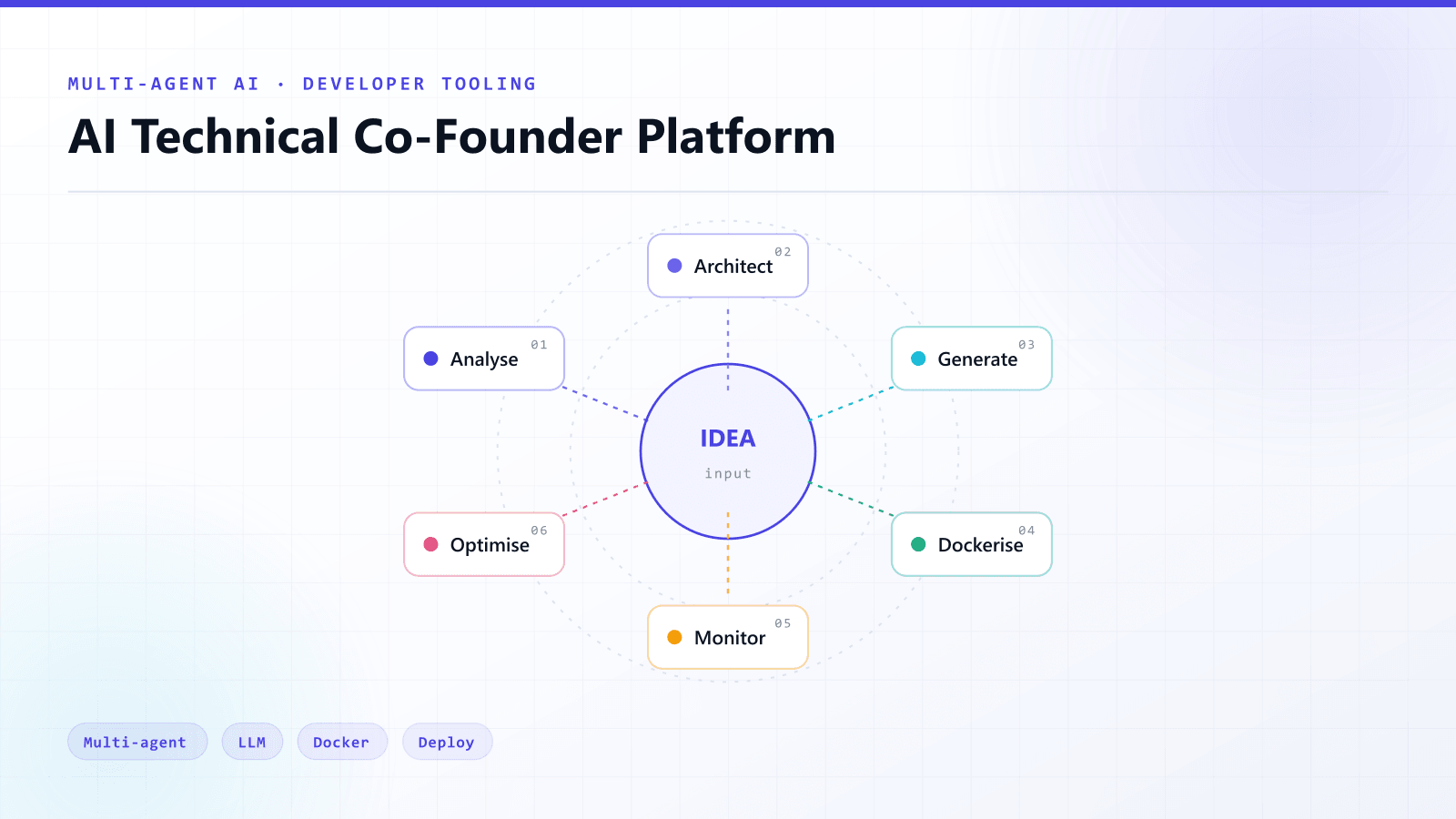
An autonomous multi-agent system that analyses a startup idea, designs the technical architecture, generates backend structure, creates Docker and deployment configuration, analyses production logs, and suggests improvements and optimisations.
- Year
- 2025
- Role
- Solo — architecture and implementation
- Source
- Public repository
Technologies
- Python
- LLMs
- Multi-Agent Systems
- AI Agents
- Docker
- Backend Architecture
The problem
A non-technical founder with a validated idea faces a wall: what should be built, in what order, on what stack, and how does it get deployed and watched once it is live. That is a chain of judgement calls, not one question.
The solution
Rather than one prompt doing everything, the work is split across specialised agents that hand off to each other — analysis, architecture, code structure, infrastructure, then production feedback. Each agent has a narrow brief and a structured output the next stage can consume.
Architecture
How it is put together.
Idea analysis
An agent decomposes the idea into product surface, core entities, constraints and technical risks.
Architecture design
An architecture agent proposes services, data model and stack choices with the reasoning attached.
Backend generation
A code agent lays out the backend structure that matches the chosen architecture.
Deployment configuration
An infrastructure agent produces Docker and deployment configuration for the generated structure.
Production analysis
A monitoring agent reads production logs and reports what is failing and where.
Improvement loop
Findings feed back as concrete optimisation suggestions, closing the loop from idea to running system.
Key features
What it actually does.
- Specialised agents with narrow, composable responsibilities
- Structured handoffs so each stage consumes the last one's output
- Architecture proposals with explicit reasoning attached
- Generated backend structure and Docker/deployment configuration
- Production log analysis feeding improvement suggestions
Engineering challenges
The parts that were hard.
Agents drift without structure
Free-text handoffs between agents compound ambiguity. Constraining each output to a defined shape kept later stages from inventing detail.
Scope control
An architecture agent will happily design a distributed system for a landing page. Keeping proposals proportionate to the idea required explicit constraints.
Outcomes
What came out of it.
Qualitative outcomes only — no invented benchmarks or metrics.
An end-to-end path from idea to architecture to deployable configuration
A reusable pattern for multi-agent handoffs with structured contracts
Production feedback wired back into the same system that designed it
Next project
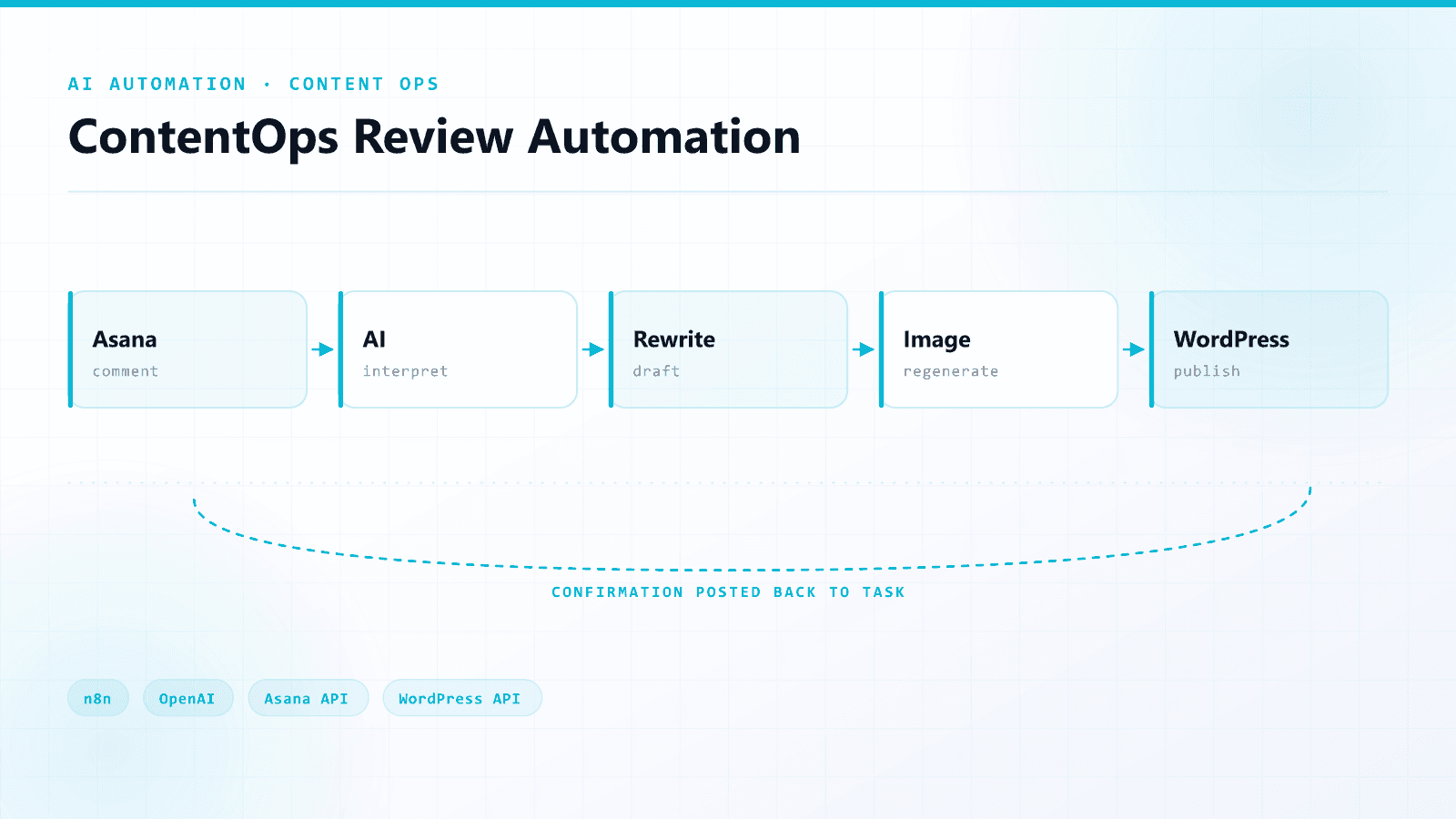
ContentOps Review Automation
Asana feedback becomes a rewritten, re-illustrated, republished WordPress post — untouched by hand.
Let’s build
Want something like this for your business?
Tell me the problem and I will come back with an architecture, a scope and a timeline.