AI ID Verification & Fraud Detection
Computer Vision / KYC / Fraud & Forensics
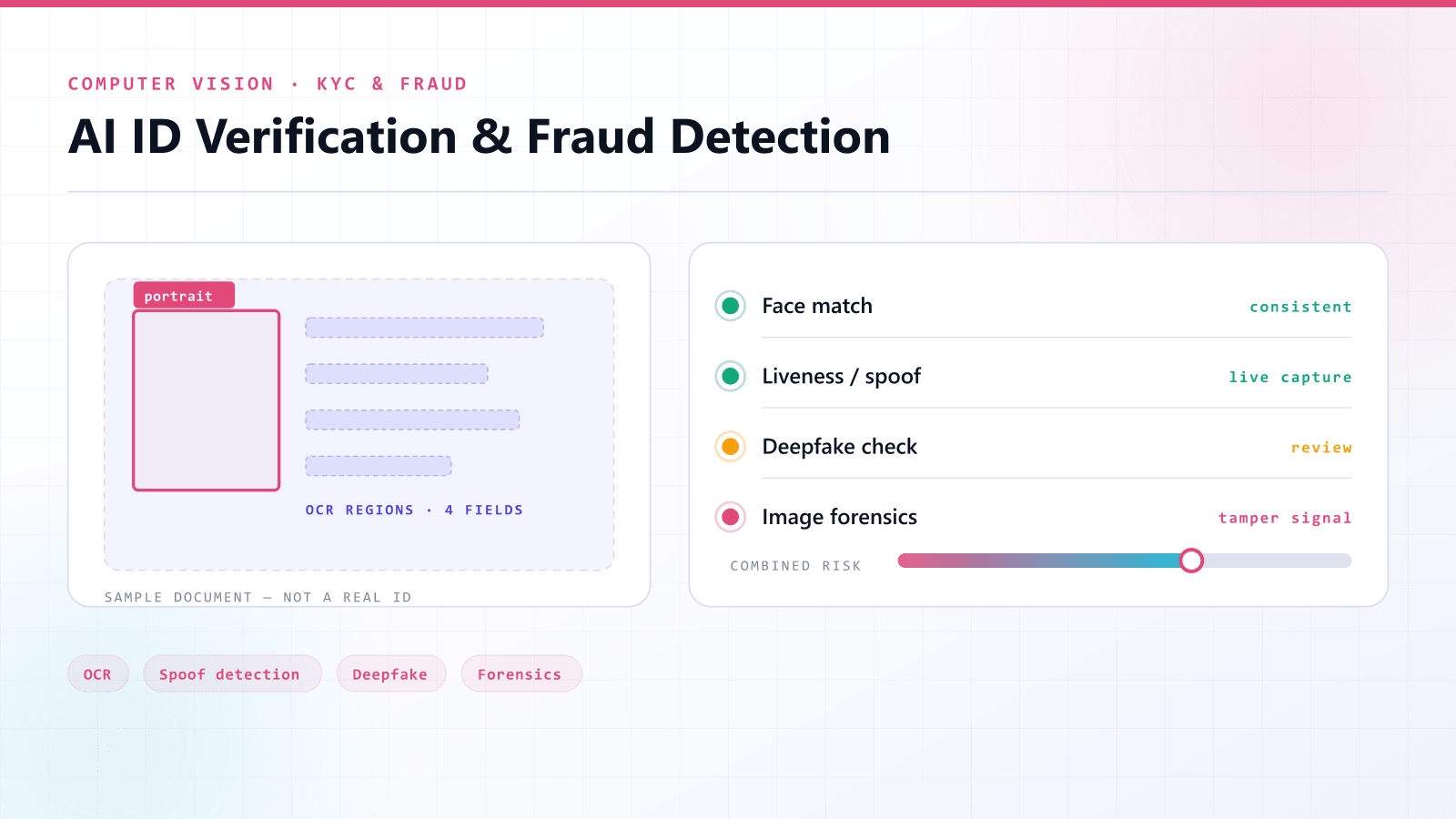
An identity verification pipeline built in a professional setting, combining computer vision, OCR, face analysis, presentation-attack detection, deepfake detection and image forensics to flag fraudulent identity documents and manipulated media.
- Year
- 2025
- Role
- Associate Data Scientist, Programmers Force
- Source
- Not public
Technologies
- Python
- PyTorch
- YOLO
- OpenCV
- OCR
- Deep Learning
- Image Forensics
The problem
Remote onboarding means a business never meets the customer. Fraud arrives as a printed photo held to a webcam, a screen replay, a digitally retouched document, or a fully synthetic face. Any one of these passing verification is a compliance failure.
The solution
A layered verification pipeline. Each layer answers a narrow question — is this a document, what does it say, is the face live, is the media authentic — and a combined risk assessment is produced from their independent signals rather than a single opaque score.
Architecture
How it is put together.
Document detection
Detection models locate the document in frame, classify its type and correct perspective before any reading is attempted.
Text extraction
OCR reads the relevant regions; extracted fields are validated for structure and internal consistency.
Face analysis
The portrait region is located and compared against the submitted selfie for identity consistency.
Presentation-attack detection
Spoof models separate a live capture from a printed photo, screen replay or mask.
Synthetic media detection
Deepfake and AI-generated image detection models flag faces and documents that were never photographed.
Forensics & risk
Image forensics surfaces signs of digital manipulation; all signals combine into a reviewable risk assessment.
Key features
What it actually does.
- Document detection, classification and perspective correction
- OCR field extraction with structural validation
- Face detection and identity consistency checks
- Presentation-attack / spoof detection
- Deepfake and AI-generated image detection
- Image forensics for tamper indicators
- Explainable per-signal output rather than one opaque score
Engineering challenges
The parts that were hard.
Attacks move faster than datasets
Generative models improve continuously, so a detector trained once decays. Retraining and evaluation had to be treated as a standing process, not a milestone.
Both error types are expensive
A false accept is a fraud loss; a false reject is a lost customer. Thresholds were tuned against that trade-off rather than accuracy alone.
Real-world capture quality
Production images are blurry, glared, cropped and low-light. Robustness under degraded capture mattered more than benchmark performance.
Outcomes
What came out of it.
Qualitative outcomes only — no invented benchmarks or metrics.
A multi-signal verification pipeline used in a production KYC context
Independent, explainable signals rather than one black-box decision
Detection coverage spanning physical spoofing and synthetic media

Next project
AI Technical Co-Founder Platform
Autonomous agents that take a startup idea from architecture to Docker to production analysis.
Let’s build
Want something like this for your business?
Tell me the problem and I will come back with an architecture, a scope and a timeline.