Voice AI Assistant
Real-Time Voice / LLM / Docker
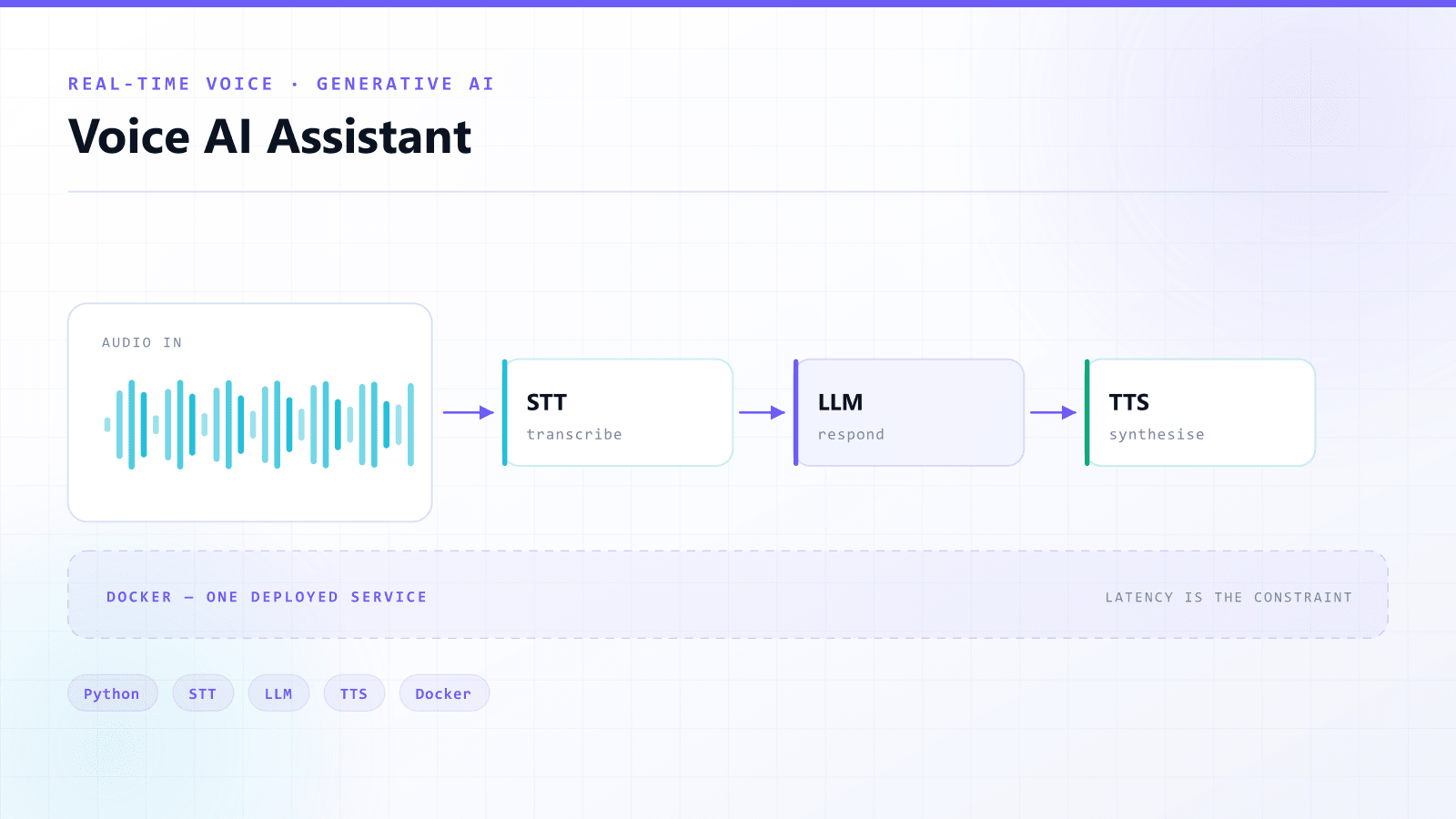
A real-time voice system integrating speech-to-text, LLM-based response generation and text-to-speech, deployed with Docker so the whole loop runs as one service.
- Year
- 2025
- Role
- Solo build
- Source
- Public repository
Technologies
- Python
- STT
- LLMs
- TTS
- Docker
- Real-Time
The problem
Voice assistants are three systems pretending to be one. Speech in, reasoning, speech out — and every handoff between them adds latency the user hears as an awkward pause.
The solution
Build the loop as a single deployable service. Transcription, generation and synthesis are wired together with latency treated as the primary constraint, and the whole thing is containerised so it runs the same anywhere.
Architecture
How it is put together.
Speech to text
Incoming audio is transcribed in real time.
LLM response
The transcript is answered by a language model.
Text to speech
The response is synthesised back into audio.
Containerised deployment
The full loop ships as a Docker service.
Key features
What it actually does.
- Real-time transcription
- LLM-generated responses
- Speech synthesis back to the user
- Single containerised deployment
Engineering challenges
The parts that were hard.
Latency compounds
Three stages each adding a delay produce a conversation that feels broken. The engineering is in the seams, not the models.
Outcomes
What came out of it.
Qualitative outcomes only — no invented benchmarks or metrics.
A complete voice loop running end to end
Deployed as one Docker service rather than three processes
Next project
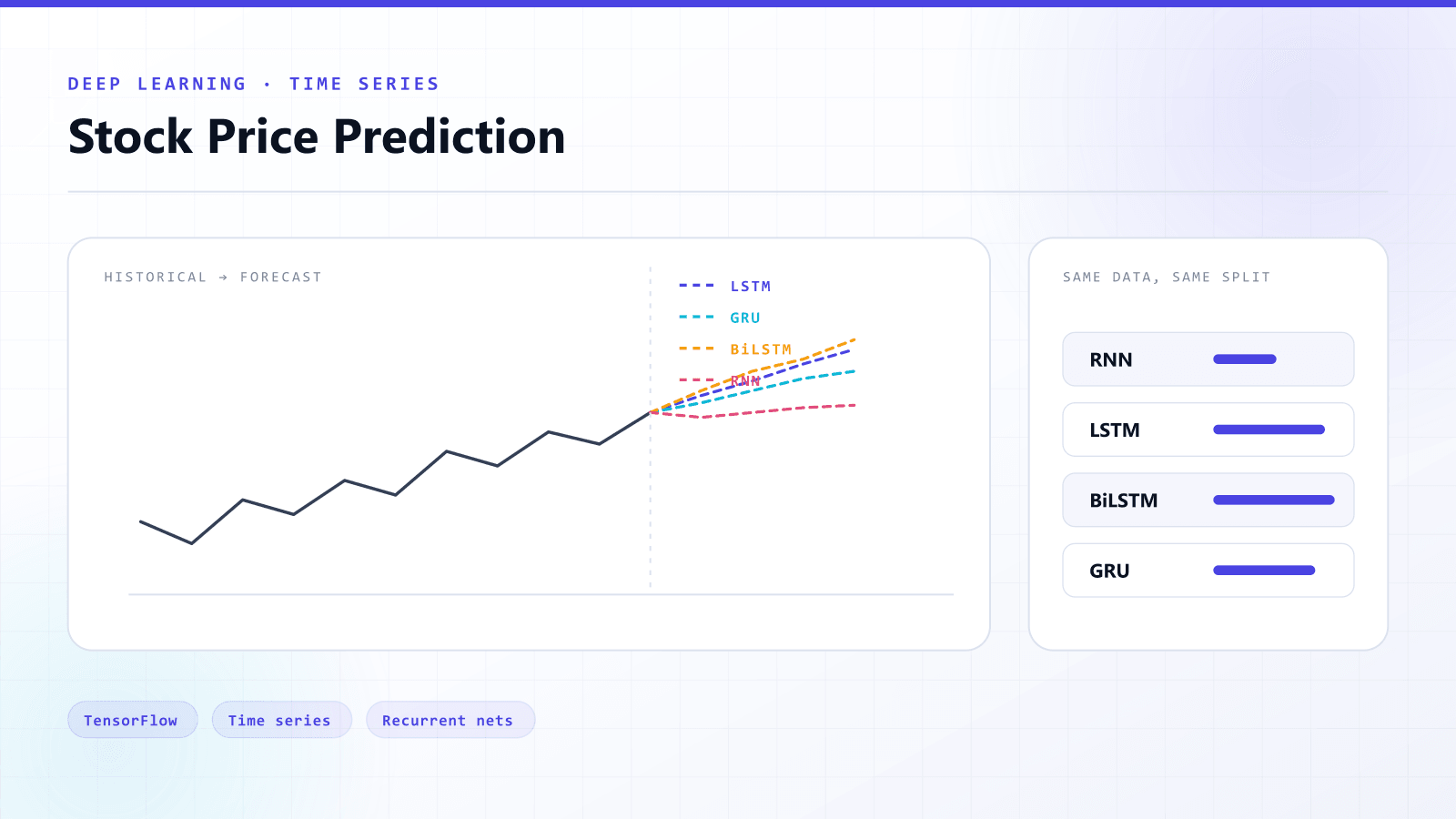
Stock Price Prediction
Forecasting with RNN, LSTM, BiLSTM and GRU architectures compared on historical data.
Let’s build
Want something like this for your business?
Tell me the problem and I will come back with an architecture, a scope and a timeline.